
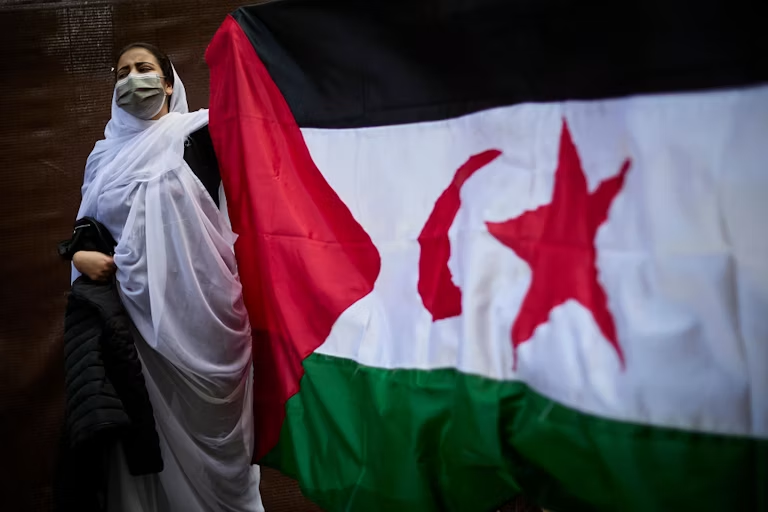
Western Sahara Conflict Endures as Morocco-Polisario Dispute Remains Unresolved
The conflict between Morocco and the Polisario Front, dating back to 1975 when Spain withdrew its colonial rule of Western Sahara, continues. Morocco invaded with military forces, violating international law. Many Moroccan civilians, backed by the military, crossed the border to assert Morocco’s claims. Western Sahara is often called Africa’s last colony and is a UN Non-Self-Governing Territory.
In 1991, Morocco and the Algeria-based Polisario Front, a liberation movement for Western Sahara, mutually agreed to a United Nations-brokered ceasefire in preparation for a referendum on self-determination. However, Morocco has declined to hold such a vote if independence is presented as an option. Consequently, the ceasefire concluded in 2020.
The Morocco–Polisario territorial dispute has left Sahrawis, the indigenous people of Western Sahara, split between occupation, exile, and a low‑intensity war zone, with deep impacts on rights, daily life, and identity that now span three generations. An estimated 173,000 Sahrawis live in five refugee camps located in southwestern Algeria.
Human Rights Watch, HRW, has written that, according to World Population Review, a majority of the population of the Western Sahara now consists of Moroccans who started to settle in the region when the territory came under Moroccan occupation.
The settler occupation has altered the demographics, shifted the balance, and diluted the Sahrawi population and political strength.
Morocco’s investments in urban infrastructure, port expansions, and renewable energy projects disproportionately benefit Moroccan enterprises, according to local Sahrawi activists. The European Court of Justice, CJEU, invalidated major trade deals that exploited Western Saharan resources without the Sahrawi people’s consent or financial benefit, such as the EU-Morocco fisheries agreement in 2024. The court ruled the pact invalid because it included disputed Western Sahara waters without the Sahrawi people’s consent.
Morocco’s Western Sahara Policies Draw Civil Liberties Concerns
HRW and others document systematic repression of expression for an end to the occupation. Sources have noted security forces ban or break up Sahrawi demonstrations, block associations, monitor activists, prosecute people under “territorial integrity” laws, and use beatings, torture, and unfair trials against prominent figures.
The US State Department report 2021-2025 on Morocco Respect for Civil Liberties section noted that speech critical of the state position related to territorial integrity and Western Sahara was criminalized and could result in punishments ranging from fines to imprisonment.
The latter report referenced The UN secretary-general’s October annual report dated 2025 regarding the situation in Western Sahara, submitted pursuant to the MINURSO mandate, noted that the Office of the United Nations High Commissioner for Human Rights, OHCHR, was not permitted to conduct any visits to the region for the eighth consecutive year and urged the government and other parties to address outstanding human rights problems and enhance cooperation with OHCHR.
Moroccan authorities maintain a strict ban on independent monitoring in Western Sahara, heavily restricting access for international journalists, human rights NGOs, and foreign parliamentary delegations. This de facto blockade isolates the Sahrawi population and severely hampers the ability of human rights organizations to document abuses, Human Rights Watch and Amnesty International support this statement..
Western Sahara possesses a wealth of natural resources
Western Sahara contains phosphate deposits, which help make the country one of the world’s top fertilizer exporters. According to Rabat, losing the territory would mean losing a strategic position of control over 70% of global phosphate reserves.
The cold, nutrient-rich waters of Western Sahara’s Atlantic coast make it one of the world’s most productive marine environments. It’s a major economic hub, accounting for 60% to 70% of Morocco’s annual catch. Rabat used its territorial claim to establish fisheries agreements with Europe, which were canceled by the CJEU. Foreign interests also fish in the occupied waters through Moroccan arrangements. A processing industry has emerged along the coastline.
The territory of Western Sahara features significant potential for offshore oil and gas, as well as large-scale onshore wind and solar energy development. Various energy and human rights organizations, including the US Energy Information Administration’s World Shale Gas and Shale Oil Resource Assessment, support this statement.
Morocco’s Autonomy Plan is void of self-determination
Over 120 countries, including the US, France, and Spain, endorsed Morocco’s Autonomy Plan submitted in 2007 to the UN as the basis for resolving the Western Sahara dispute. The plan proposed making the territory an autonomous region under Moroccan sovereignty. The UN Security Council endorsed the plan in October 2025 as the primary basis for negotiations, calling genuine autonomy under Moroccan sovereignty the most feasible solution.
HRW writes in its 2026 report that the UNSC decision puts self-determination for the indigenous people of Western Sahara at risk. The resolution endorses Morocco’s Autonomy proposal that does not include independence as an option, provide for reparations, or define the Sahrawi people of Western Sahara, who possess the right to self-determination.
The Islamic Post Staff