
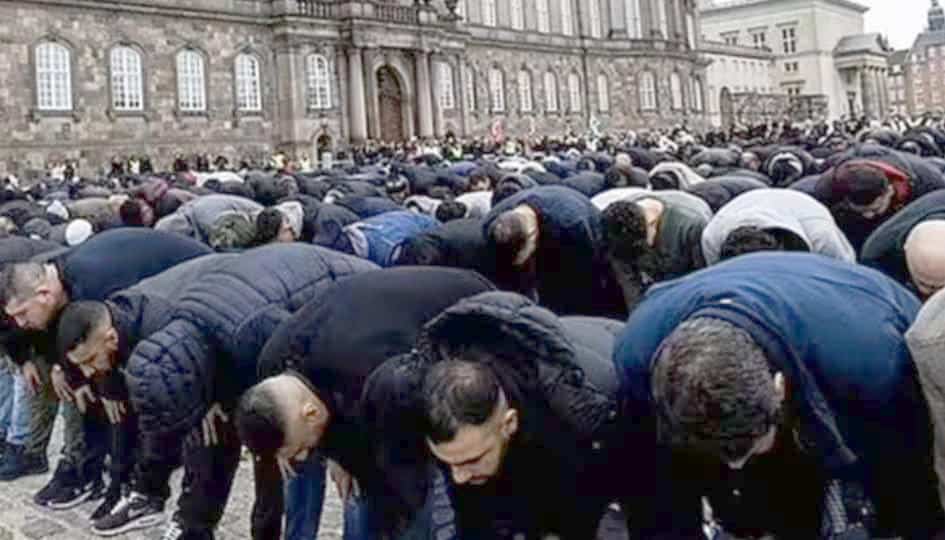
Islamic Call to Prayer Faces Ban Under Left-Wing Danish Government
Denmark’s immigration minister has announced plans to ban the Islamic call to prayer, claiming parts of the country felt like “a suburb of Islamabad”.
Morten Bødskov, a member of the centre-Left Social Democrats party, said the new government would resume an investigation into the legality of imposing a ban.
“The call to prayer should not be heard over Danish rooftops,” the minister told news outlet Ritzau. “It has no place in Denmark, and you shouldn’t be in any doubt whether you’ve ended up in a suburb of Islamabad when you walk around Denmark.”
In parts of the country, such as Copenhagen, bylaws already forbid the call to prayer being broadcast from loudspeakers in minarets because of strict noise limits.
Mr Bødskov also claimed that a creeping “Islamisation” in Denmark was “taking up too much of the public space”.
The Adhan, or call to prayer, is performed five times a day to summon Muslim worshippers to their mosque, traditionally via loudspeakers in minarets.
It is the third time a Danish immigration minister has tried to build a legal framework for banning the call to prayer, after similar attempts by the Social Democrats in 2020 and 2025.
Denmark has imposed some of the toughest migration rules in Europe under Mette Frederiksen, the country’s Left-leaning prime minister, who began her third term earlier this month.
Under its so-called “ghetto” laws, Danish authorities are allowed to force migrants to relocate from a neighbourhood if it has too many foreign residents.
In some cases, asylum seekers are required to give up their jewellery and other valuable possessions to cover their housing costs, and they receive no financial support if their claim is rejected.
At the height of the refugee crisis in 2015, when more than a million people fled from the Middle East to Europe’s borders, Denmark accepted far fewer asylum seekers than its neighbours.
Any attempt by Denmark to ban the call to prayer could face legal hurdles, as the government’s investigation weighs up religious freedoms against the rights of residents near mosques.
The Danish constitution enshrines the right to public worship, but there are exceptions, such as bans on anti-democratic preaching and donations to banned groups.
In Germany and Britain, there are strict limits on when a mosque may broadcast a call to prayer, as well as volume limits, to avoid disturbing non-Muslim neighbours.
In a population of around six million, around 270,000 Muslims live in Denmark.
The country also has an estimated 100 mosques, including the Grand Mosque of Copenhagen, which does not issue an outdoor call to prayer under an agreement with local authorities.
If religious freedom means anything it must be for all – and that includes Muslims
Ms Frederiksen started a new term in power this month despite failing to secure a majority in the March elections, which led to months of complex coalition talks.
She managed to form a four-party government with the centrist Moderates, the Left-leaning Social Liberals and the Green Left, in what has been dubbed a “four-leaf clover” coalition.
The coalition also depends on support from the Red-Green Alliance, an eco-socialist movement similar to the Green Party in Britain under Zack Polanski.
Ms Frederiksen called a snap election in March as she sought a stronger mandate to confront Donald Trump, the US president, who has repeatedly threatened to take over Greenland, an autonomous Danish territory.
By James Rothwell
Berlin Correspondent